Water and coffee — an intriguing pair

Do not pour... poor-quality water
What is water to coffee? This simple compound of hydrogen and oxygen is like yin to yang: the complement without which coffee itself makes little sense. Scientifically speaking, water is the solvent that allows the aromas hidden in coffee to be released.
From a chemical perspective, minerals in water, mainly magnesium (Mg), calcium (Ca) and sodium (Na), help dissolve sugars, fats and alkaloids inside the bean. This matters to anyone hoping to brew a rich, complex cup. Why? Because, contrary to some opinions, minerals are not an obstacle to developing coffee flavour: quite the opposite. Using water stripped of minerals, or demineralised water, worsens the taste and can make the brew feel rough. That does not mean highly mineralised water is the answer either. Too many minerals also distort the profile, making the coffee flat.
Does ideal coffee water exist?
What should water for coffee be like? As mentioned, it should contain minerals, but in the right amount. Its pH should also be fairly balanced, around 6.5–7.5. It should be neither too hard, which inhibits aroma release, nor too soft, which gives an unpleasant sour aftertaste. The SCA recommends hardness between 120 and 160 ppm. Yet tap water in most Polish homes is around 330–350 ppm. What then?
There are several ways to address hard water. The simplest, cheapest and reasonably effective is filtration. It may not be a completely perfect solution, but it softens water and helps produce a more pronounced, balanced brew. Another option is to find a suitable bottled water. This lets you control how different minerals affect the flavour.
Does that work? Certainly. Do we recommend it? Well, creating piles of empty water bottles is neither environmentally friendly nor kind to your wallet. Other options include obtaining water from a friendly café or making your own brewing water by adding appropriate mineral quantities to demineralised water.
Do not scald the coffee!
Time to brew... but are you sure? Pouring boiling water over freshly ground, aromatic beans is the greatest disservice you can do your favourite Arabica. Contact with water that is still boiling does not help release its flavours. Quite the opposite: it scalds the grounds, stripping away their flavour.
What is the right water temperature? Most baristas and connoisseurs suggest around 88–94°C. A litre of water boiled in a kettle reaches that range after roughly three or four minutes, during which you could grind the beans in your favourite grinder. Adjusting temperature also influences taste: hotter water helps release bitterness, while slightly cooler water favours the bright, acidic notes some people love.
Adding water is not everything. Now the two ingredients need the most important thing: time. Ground beans must get to know the water before trusting it with their flavours. How long should we wait? That depends on the method. An ultra-fast espresso takes thirty seconds, while pour-over methods may need up to four minutes.
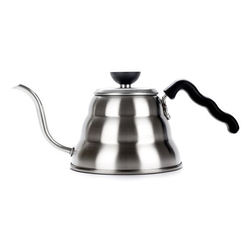
Pouring technique also matters to flavour balance. With a Chemex, for example, add water slowly in stages. A suitable kettle helps control the hot stream precisely. If you favour a classic trusted by the experts, choose our favourite “pretty little kettle”, the Buono Kettle, known as a barista's best friend.
If reading this makes you want to test which temperature brings out your favourite coffee's aromas best, wonderful! We will stop distracting you and get back to pouring water ourselves — into coffee, of course! :D